A Rainy-Day Rewatch for Following Reflections
A rainy-day rewatch for following reflections shows how windows, mirrors, and polished surfaces organize a film’s frame and guide your attention.
The common mistake in a rainy-day rewatch for following reflections is to pause at every doubled face and ask what it symbolizes. That turns a moving image into a puzzle and can make you miss the craft of the shot: how glass, metal, and camera position divide the frame into layers.
Choose a film you know and follow one reflective surface through a scene. The useful question is not what the surface stands for, but how its changing image directs your eye, connects spaces, or interrupts the action.
What does the reflection add to the frame?
Begin with the material and its placement. A window can combine an interior with the street; a mirror can bring a doorway into the composition; a polished counter can catch only a passing glint. Each gives the filmmaker a different way to arrange images within the shot.
Track what the surface shows, what it obscures, and what remains visible beside it. A reflection is not a neutral duplicate: its angle, brightness, and clarity determine whether it competes with the direct view or sits quietly behind it.
Rain adds movement to glass. Droplets can scatter a streetlight, break up a figure, or layer exterior highlights over a face. Watch how those marks change the image as the scene unfolds, rather than treating them as a ready-made symbol.
How should you watch and take notes?
Pick a scene with a visible reflective surface and a clear change to follow, such as a person crossing a mirrored lobby or a car passing outside a window. Keep a notebook or a notes app open, but let the first viewing play at normal speed so you can see how the composition guides attention over time.
On a second pass, focus on the surface. Write a short description of what changes, such as “streetlight crosses the window” or “mirror catches the open doorway.” If the image is hard to see, adjust your screen or room lighting; avoid pausing so often that you lose the rhythm of the shot.
Replay the moment when a person turns, an object moves, or the camera reframes. Compare the reflection before and after, then note what changed and what your eye followed. That gives you a practical account of the shot’s construction without requiring a symbolic explanation.
What changes when you follow one reflection?
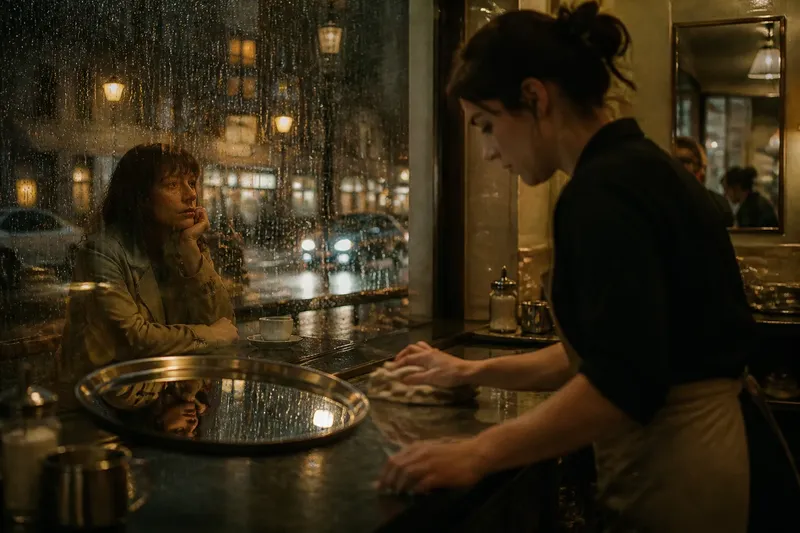
Imagine an invented café scene: a worker wipes a counter while a customer waits beside a rain-streaked window. At first, the customer’s face is clear and headlights drift across the glass. The worker moves a metal tray, which briefly catches the customer’s sleeve and the passing lights.
On a second viewing, you notice that the tray brings a small fragment of the customer into the foreground without the customer moving. When the worker sets it down, the lights disappear from the metal. Your notes might read, “tray catches sleeve” and “lights vanish when tray lowers”; the observable result is a momentary shift in the frame’s balance.
The direct image and reflected image work together here. Watching only the tray would leave out the customer’s stillness, while watching only the customer would miss the brief interruption on the counter. The scene holds both layers, and your attention moves between them.
How do windows, mirrors, and polished surfaces differ?
Windows can place an interior and an exterior in the same shot. Depending on the angle and light, a room lamp may sit over the street beyond, or the street may dominate while the room recedes. Rain, condensation, and curtains change what remains legible.
Mirrors offer another view of the room. Their placement can include an offscreen doorway, repeat a figure, or extend the apparent depth of a set. Notice how that view relates to the direct image: it may align closely with it or create a distinct area of attention.
Polished surfaces often give fragments rather than a full second view. Chrome, a glass tabletop, lacquer, and wet pavement can catch a face or lamp briefly, especially as an object or camera shifts. Their effect often comes from the timing and shape of the glint.
Which questions help you read the shot?
Is the reflected image clear or broken up?
A sharp image can hold attention as a second view, while a smudged or rippled one may register mainly as texture. Note which one occurs, then decide whether the reflection competes with the direct image or supports its background.
Does the reflection show space outside the direct frame?
Check whether it includes a person, doorway, or light that the camera does not show directly. If it does, note how the shot uses that added space; if it does not, focus instead on how the surface alters what is already in view.
What causes the reflection to change?
Compare the change with a character’s movement, a camera adjustment, a passing light, or an object being repositioned. If one event coincides with the change, note the connection; if the cause is unclear, describe the change without assigning it a source.
Where does your eye go first?
Watch the scene at full speed and notice whether you look at the direct action or the reflected layer first. If the reflection draws your eye, record what makes it prominent; if it does not, note how it contributes without taking over the shot.
How can you make notes that lead to a useful decision?
Keep visible details separate from interpretation. “The window carries a lamp across the actor’s cheek as the camera pans” describes the image; “the overlap makes the room feel enclosed” is an interpretation. You can keep both, but distinguishing them makes it easier to revise an idea when the next shot changes the effect.
- Observe the surface: If you can identify glass, a mirror, metal, or wet pavement, note it; if you cannot, record the visible effect without guessing at the material.
- Check what appears in it: If the reflection shows a person, object, or light, name it; if it is too indistinct, describe its shape or brightness instead.
- Compare the direct and reflected views: If they overlap or compete, note where; if they remain separate, record how each occupies the frame.
- Watch for a change: If the image shifts with a person, camera, light, or object, note that event; if no cause is clear, describe only the before-and-after difference.
- Locate the reflection: If it sits near the center, overlaps a face, or fills an empty area, record its position; if it stays at the edge, note whether it still attracts attention.
- Replay at full speed: If the reflection remains noticeable in motion, treat it as an active part of the composition; if it disappears at normal pace, describe it as a fleeting detail rather than a dominant feature.
Say you choose an invented scene in which a character waits beside a shop window as a delivery truck passes. Your starting note is “bright shape in glass,” with no clear source. You replay the moment, see the shape move in time with the truck, then check the full-speed shot and find that it vanishes almost at once. The resulting note is “truck light briefly crosses the window”; you can describe it as a passing visual accent, while leaving its broader significance undecided.
When is the reflection simply part of the image?
A reflection may add spatial detail, texture, or movement without becoming a separate narrative clue. A wet street can scatter a shop sign, a mirror can make a narrow room feel deeper, and a window can layer a face over a passing vehicle. Those effects are already part of the film’s visual design.
For your rainy-day rewatch following reflections, finish by watching the scene once more without pausing. Keep one note about the surface, one about a change, and one about where your attention went; the resulting description can be precise without forcing the image to answer a question the scene never raises.