How Film Sets Shifted from Painted Flats to Camera-Ready Rooms
Film set design history is not a march from painted illusion to realism. Learn how camera needs, actor movement, and studio craft shaped the spaces on screen.
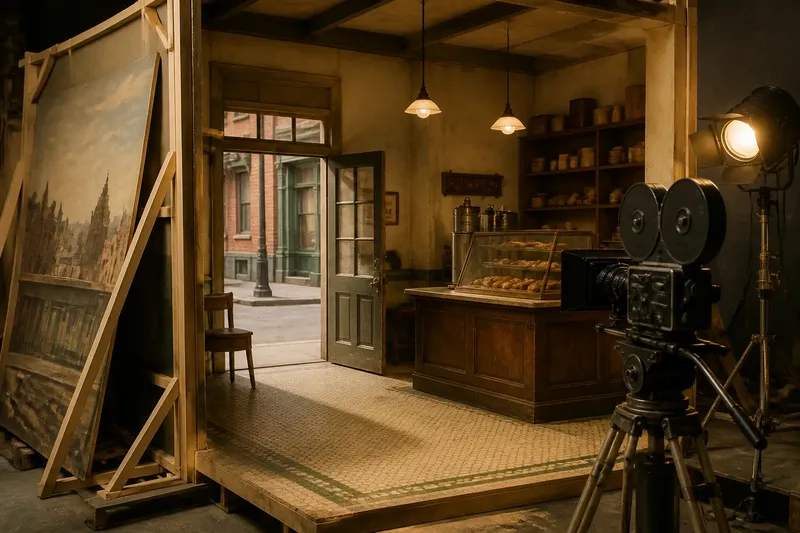
The most common mistake in tracing film set design history is to treat painted scenery as a primitive stage on the way to realistic rooms. That shortcut erases what each method was built to do: a painted flat could make a legible image from a chosen angle, while a constructed room could support more camera positions and actor movement. The tradeoff was never simply false versus real.
How did early studio scenery borrow from the stage?
Early film studios drew on theater practices, including flats: lightweight frames covered with scenic material and painted to suggest walls, windows, streets, or distant landscapes. Placed at an angle, several flats could create the impression of depth without requiring a fully built location.
The arrangement suited a camera that held a relatively fixed view. A painted door did not need to open if the scene only required an actor to stand beside it. The image could be persuasive within the frame even when the scenery did not describe a complete room.
This approach carried a clear visual convention. Actors often faced outward, and the set arranged its details for a composed view, much as theatrical scenery addressed an audience. A shallow window or a wall that mainly framed an entrance may reveal that the scene depended on a particular viewpoint rather than unrestricted access to the space.
What changed as cameras and scenes became more mobile?
Camera movement placed new demands on scenery. A tracking shot could travel past a wall, cross a doorway, or expose a corner that a flat had not been designed to support. Designers and crews had to consider how the set would look across a sequence of views, not just in one composition.
That change did not eliminate painted scenery. A flat could still extend a room, conceal the edge of a studio, or complete a background that the camera would approach only from a controlled angle. The choice depended on what the scene asked the camera and performers to do.
As blocking grew more complex, the shape of a set became part of the action. A narrow passage could constrain a crossing; an open doorway could make an entrance prominent. Corners and practical openings mattered because the camera, actors, lighting, and other equipment all needed space to work.
Why did location shooting complicate the idea of realism?
Filming on location introduced real surfaces and existing layouts, but those places did not automatically serve the scene. A room might have an awkward sightline or limited space for the camera. Studio construction offered more control over walls, access, and the positions of doors and furniture.
Filmmakers could also combine the two approaches. An exterior might be filmed on a real street, with an interior built elsewhere. The cut between them asked viewers to accept that both spaces belonged to one place, so designers could carry visual clues such as tile, doorway shape, or the position of a counter across the transition.
Imagine a fictional film setting a conversation in an old neighborhood bakery. The crew films the exterior on a real street, then builds a cramped interior on a soundstage so the camera can move around the actors. If the interior carries over the street-facing counter, narrow entrance, and worn tile color, viewers can read the cut as a continuous place; if it instead presents a grand, polished room, the shift may suggest a different bakery or a deliberate change in tone.
How do painted flats and built rooms serve different scenes?
A painted flat works well when a scene needs a controlled view, a suggestion of distance, or a boundary that the camera will not cross. A built room is useful when actors must move through the space or the camera needs to see it from several angles. Neither method is inherently more convincing; each has different demands to meet.
Designers may also build only the parts that the scene needs. A partial room can support a moving camera if its openings, surfaces, and actor paths are planned for the shots. What remains outside the frame does not have to be fully constructed, but the visible details need to support the action.
What questions help you read a film set?
How can you tell a room was designed around the camera?
Look for a broad, unobstructed path through the furniture, a missing wall, or a clear view into adjoining areas. These choices may indicate that the camera needs access to the scene rather than a room arranged as it would be in ordinary use.
Why can a constructed set feel more convincing than a real room?
A constructed set can place openings, furniture, and surfaces where the scene needs them, making actor movement and sightlines easier to follow. A real location may be less useful if its layout obscures the action or conflicts with the shot.
When does a painted backdrop still work?
It can suggest a distant view or complete a composition when the camera remains at an angle that supports the illusion. If actors or camera must pass close to it, the flat may need to give way to a more practical construction.
Can you always tell a location from a set?
No single visual clue settles the question, since a scene may combine a real exterior with a built interior. Follow the doorways, floor surfaces, and paths across cuts to see whether the spaces connect in a way the scene asks you to accept.
How can you trace a set’s design through a scene?
Choose one threshold, such as a doorway or stair landing, and follow it across the scene. Notice who passes through, what the opening reveals, and whether the camera treats it as a boundary, a route, or a place to pause.
Then attend to what the frame leaves out. A corridor that ends beyond the camera or a window that offers a controlled view can suggest a larger world without showing it. Film set design history becomes easier to read when you ask what each technique lets a scene show, hide, or physically support.